
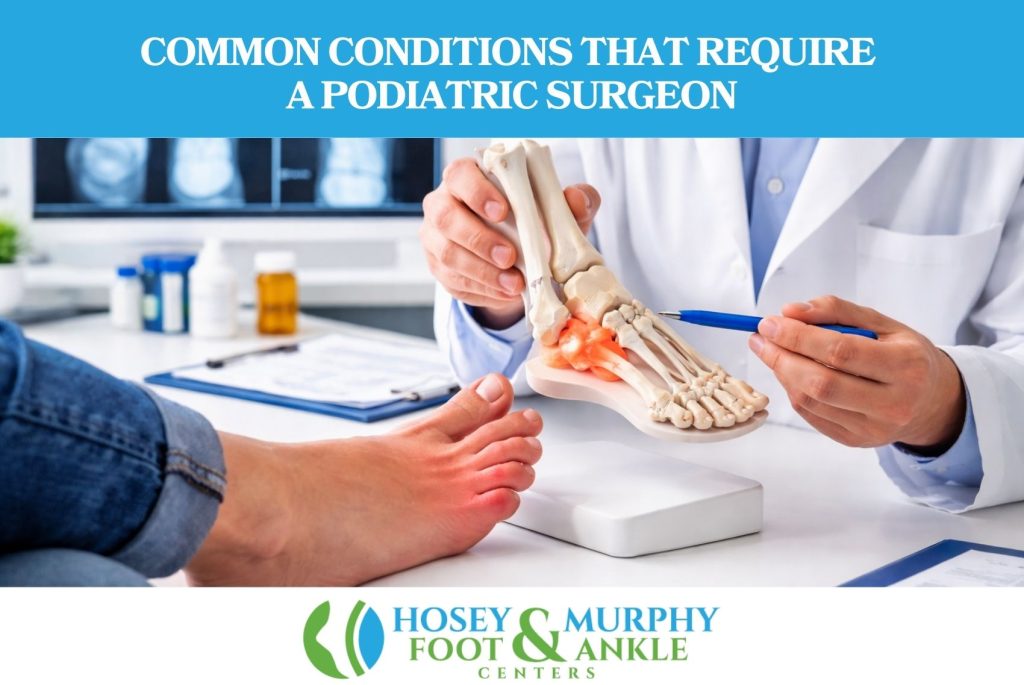
Expert Foot and Ankle Care at Hosey and Murphy Foot & Ankle Centers
Foot and ankle pain can significantly affect your mobility, independence, and overall quality of life. While some conditions can be treated conservatively with rest, orthotics, or medication, others require the expertise of a podiatric surgeon to restore function and relieve pain. At Hosey and Murphy Foot & Ankle Centers, our board-qualified podiatrists provide advanced surgical and non-surgical care for a wide range of foot and ankle conditions.
Understanding when surgery may be necessary—and what conditions commonly require it—can help patients make informed decisions about their care.
What Is a Podiatric Surgeon?
A podiatric surgeon is a medical specialist trained specifically in diagnosing and treating conditions of the foot, ankle, and lower extremities. Podiatric surgeons complete extensive education, including medical school, hospital-based surgical residency training, and ongoing continuing education. They are uniquely qualified to perform both conservative treatments and complex surgical procedures when necessary.
Common Conditions That May Require Podiatric Surgery
1. Bunions (Hallux Valgus)
Bunions are bony protrusions that develop at the base of the big toe, often causing pain, inflammation, and difficulty wearing shoes. When conservative treatments fail and daily activities become painful, surgical correction may be recommended to realign the joint and restore function.
2. Hammertoes and Toe Deformities
Hammertoes occur when the toe joints bend abnormally, leading to corns, calluses, and discomfort. In moderate to severe cases, surgery may be required to straighten the toe and relieve pressure.
3. Heel Pain and Plantar Fasciitis
Chronic heel pain that does not respond to conservative care may indicate severe plantar fasciitis, heel spurs, or tendon involvement. Surgical intervention can help release tension and reduce ongoing inflammation.
4. Achilles Tendon Disorders
Conditions such as Achilles tendon tears, ruptures, or chronic tendinitis may require surgery to repair damaged tissue and restore strength and mobility, particularly in active individuals.
5. Flatfoot Deformity
Adult-acquired flatfoot can lead to progressive pain, instability, and arthritis. When non-surgical treatments are ineffective, reconstructive foot surgery may be necessary to correct alignment and improve function.
6. Ankle Injuries and Instability
Recurrent ankle sprains, ligament tears, or fractures that fail to heal properly may require surgical stabilization to prevent long-term damage and arthritis.
7. Diabetic Foot Complications
Patients with diabetes may develop ulcers, infections, Charcot foot, or deformities that require surgical intervention to prevent serious complications, including limb loss.
8. Ingrown Toenails (Chronic or Infected)
Severely ingrown toenails that recur or become infected may need a minor surgical procedure to permanently remove part of the nail and prevent future problems.
9. Arthritis of the Foot and Ankle
Degenerative or inflammatory arthritis can cause joint pain, stiffness, and deformity. Surgical options may include joint repair, fusion, or replacement to relieve pain and restore stability.
Comprehensive Q&A: Podiatric Surgery
Q: How do I know if I need foot or ankle surgery?
A: Surgery is typically considered after conservative treatments—such as orthotics, physical therapy, or medications—fail to provide relief. Your podiatrist will evaluate your symptoms, imaging studies, and lifestyle needs before recommending surgery.
Q: Is podiatric surgery safe?
A: Yes. Podiatric surgery is generally very safe when performed by a qualified specialist. Advances in surgical techniques and minimally invasive procedures have improved outcomes and reduced recovery times.
Q: Are all foot surgeries invasive?
A: No. Many procedures are minimally invasive and can be performed on an outpatient basis, allowing patients to return home the same day.
Q: What is recovery like after foot or ankle surgery?
A: Recovery varies depending on the procedure. Some patients return to normal activities within weeks, while others may require longer healing times. Your podiatrist will provide a personalized recovery plan.
Q: Will I need physical therapy after surgery?
A: In many cases, yes. Physical therapy can help restore strength, flexibility, and mobility while reducing the risk of future injury.
Q: Can surgery prevent future foot problems?
A: When appropriately recommended, surgery can correct structural issues, relieve pain, and prevent progression of deformities or joint damage.
Q: Does insurance cover podiatric surgery?
A: Most medically necessary podiatric surgeries are covered by insurance. Our team can assist with verifying coverage and explaining your options.
Why Choose Hosey and Murphy Foot & Ankle Centers?
At Hosey and Murphy Foot & Ankle Centers, we are committed to providing compassionate, evidence-based care using the latest medical and surgical techniques. Our goal is always to start with the least invasive treatment and recommend surgery only when it is truly in your best interest.
Contact Information
Clinton Township Office
Hosey and Murphy Foot & Ankle Centers
42550 Garfield Road, Suite 103
Clinton Township, MI 48038
📞 Phone: (586) 263-4411
Harrington Office
21510 Harrington St., Suite 302
Clinton Township, MI 48036
📞 Phone: (586) 468-5445
Sterling Heights Office
Hosey and Murphy Foot & Ankle Centers
44344 Dequindre Road, Suite 420
Sterling Heights, MI 48314
📞 Phone: (586) 275-3000